
The short answer
An offering is how your product is packaged for sale: the pain it fixes and the outcome it promises, the scope, the price, the terms and the guarantee.
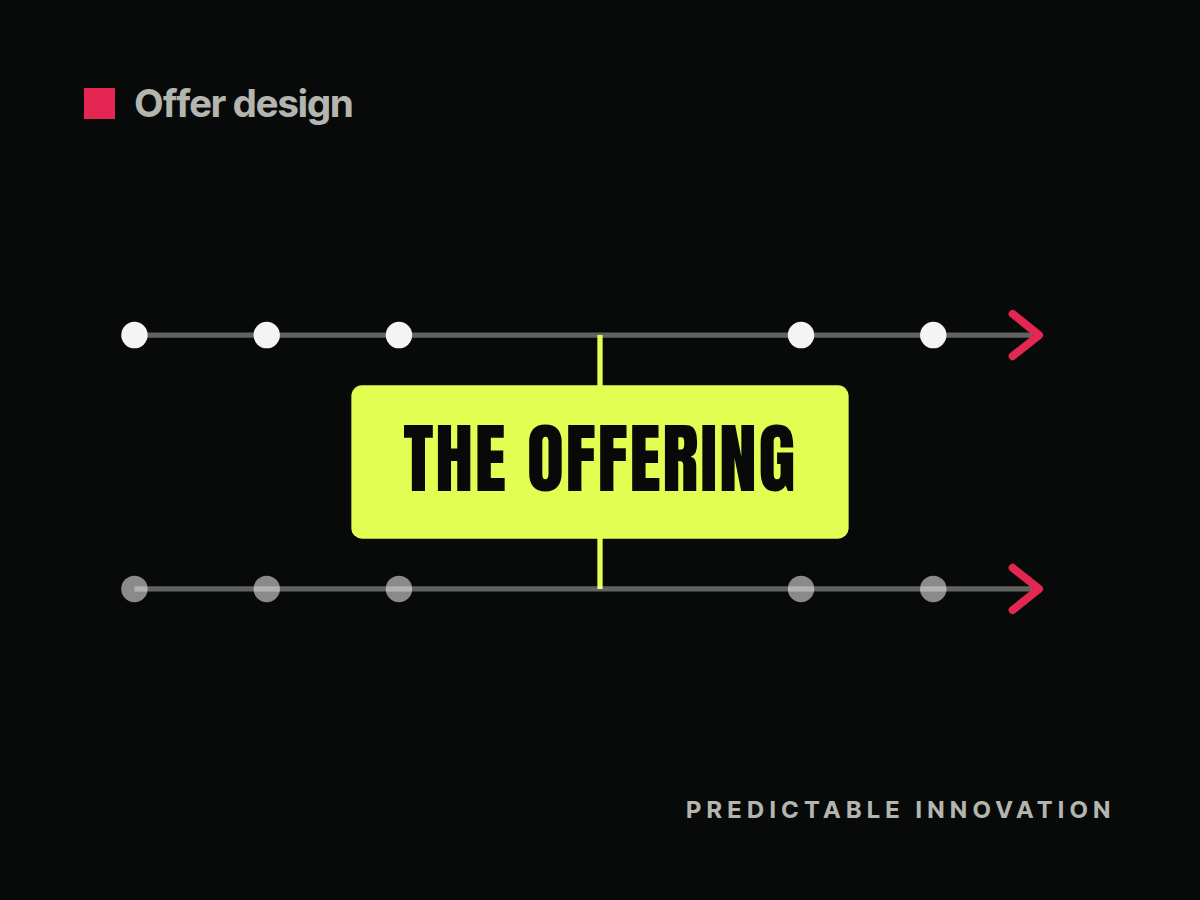
- The offering sits between two pipelines: getting the money and keeping it.
- Stalled deals, messy delivery and vanishing margins are often one offering problem.
- Buyers weigh losses more than gains, so the offering that wins is the one that feels safe to buy.
- Start with a small, low-risk entry offering, then expand once the buyer trusts you.
On this page (11 sections)
- 01 What is an offering in business?
- 02 Offering vs product: the restaurant example
- 03 Why the offering is the hinge of both pipelines
- 04 How teams break their offering
- 05 A B2B offering example: before and after
- 06 How to build a low-risk entry offering
- 07 Why low risk wins: loss aversion
- 08 Where the offering leaks, stage by stage
- 09 Questions about offerings
- 10 The bottom line
- Sources
You think it’s just the proposal. A PDF with a price. Maybe your pitch. But that’s not what’s killing your deals.
Let’s start with the answer. Your offering is how your product is packaged for sale: pain to outcome, scope, price, terms, guarantee. This guide covers what each part means, why the offering decides both how you win deals and how you keep the margin, a published before and after, and a recipe for an offering that is easy to say yes to.
What is an offering in business?
An offering is the package a buyer says yes to. It has five parts:
- Pain to outcome
- The problem the buyer pays to fix, and the result they get.
- Scope
- What is in, and what is not.
- Price
- What it costs, and how it is charged.
- Terms
- How long, and what the buyer commits to.
- Guarantee
- Who carries the risk if it doesn’t work.
Not your product. Not your pitch. Not your price. The package. It’s the packaging of your value that makes “yes” feel obvious to the buyer, and “delivered” feel obvious to your team.
That is why two companies can sell the same product into the same market and get opposite results.
The product is the same. The package around it is not.
Offering vs product: the restaurant example
The product is what you built. The offering is how you sell it, and buyers judge the package before they ever try the product.
Restaurants don’t close you with the menu. They close you before you walk in: the smell from the street, the reviews you read, the friend who said “you have to try this place.” By the time you sit down, you’ve already decided to spend money.
Now imagine that same restaurant demands a 12 course tasting menu, paid upfront, with a 3 hour commitment, before you’ve tasted a single bite. Full product complexity. Full price. Full commitment. Before you’ve seen a single result. The buyer’s brain screams: too much risk.
That is what many B2B offerings look like from the buyer’s side of the table. A low-risk offering flips it. You give them one bite first, the one that makes them say “I need more of this.” Then you expand.
Why the offering is the hinge of both pipelines
Every B2B company runs two pipelines, and the offering sits between them.
Pipeline 1: get the money
- Distribution
- Leads
- Calls
- Demos and pitches
- Proposal
- Revenue
Pipeline 2: keep the money
- Onboarding
- Delivery
- Support
- Results
- Expansion
- Margin
Break the offering and both pipelines collapse. Every deal that stalls? Offering problem. Every delivery that goes sideways? Offering problem. Every margin that evaporates? Offering problem.
The symptoms are familiar: leads vanish after pitching, deals drag for months, you lose to cheaper competitors, ops is a fire drill, margins vanish. That’s not a sales problem. Not a marketing problem. Not an ops problem.
It’s an offering problem wearing a sales problem’s clothes.
And most teams treat the symptom, not the cause: more ads, more funnels, more hires, new scripts.
How teams break their offering
Teams break their offering by trying to sell everything to everyone. The damage usually starts with a sentence that sounds reasonable in a leadership meeting.
| What the team says | What it causes |
|---|---|
| “Every client is unique.” | That’s why you can’t scale. |
| “Our sales team doesn’t get what we sell.” | Because your offering doesn’t make it obvious. |
| “Buyers don’t understand our value.” | They understand. They just don’t care. |
| “If we narrow down, we leave money on the table.” | The table is empty. |
| “We can sell a lot of products. Why limit ourselves?” | Now nobody knows what you actually do. |
Each of these keeps the offering wide, custom and risky to buy. The fix is the opposite: one pain, one use case, one small first step.
A B2B offering example: before and after
This is a published client case from Jose M Bermejo’s time leading market expansion in the USA for Plain Concepts: a B2B data platform on Azure, around $100K a year per client.
| Part of the offering | Before | After |
|---|---|---|
| What they sold | “Enterprise data platform with real-time analytics, and automated pipeline building in Azure-native architecture” | “We unify your data in 4 weeks. You’ll save 1 FTE RevOps with safer Microsoft Cloud data storage” |
| Entry point | $100K a year, 12 month contract, 3 to 6 months of implementation | A $20K front offering: a real proof of concept with real users and real data, one use case (margin visibility on the top 50 SKUs), a live dashboard in 4 weeks |
| Guarantee | None | If the team isn’t using it daily by week 5, full refund |
| Expansion | None | An $80K full platform rollout, with the $20K counted toward the contract, unlocked after the buyer has seen it work |
| The buyer’s brain | “Too risky. Let me think about it.” | “That’s not a risk. That’s a test drive.” |
The result was the first new logo in 5 years. “Same product. Same market. Same team. The only thing we changed? The offering,” in Jose’s words.
How to build a low-risk entry offering
A low-risk offering does one thing: it makes buying feel safer than not buying. It is built in three moves.
- Front offeringOne pain, one use case, the urgent one. The risk sits with you, not them.
- Trust builtReal users, real data, a result they can see.
- Expansion offeringThe full workflow. Earned, because they already trust you.
- Full valueA small entry, then the whole account.
The recipe behind the front offering has four steps:
Find the hair-on-fire pain. Not the “nice to have”: the one costing them money today.
Isolate one use case. The fastest path to proving you work.
Engineer a low-risk entry. Pricing, guarantee and scope that make yes obvious.
Design the expansion path. Where the real contract value lives, after they trust you.
The go-to-market workshop builds this with a B2B team in one day, 7 hours, in person. The team leaves with a packaged offering: an entry offering, an expansion path, a pricing model and a risk-reduction stack. For how the offering fits into the rest of the plan, see how to build a go-to-market strategy.
Why low risk wins: loss aversion
Low risk wins because buyers feel a loss more than a gain of the same size. Kahneman and Tversky’s prospect theory (1979)1 showed it first, and later estimates put the ratio at about two to one (Tversky and Kahneman, 1992)2. Your buyer isn’t calculating upside. They’re calculating risk.
That is also why the job a buyer hires you for is only half the story. The other half is what they are afraid of losing. See Jobs to Be Done examples for how to find both.
Where the offering leaks, stage by stage
Once the offering is right, each stage of the sales process still needs its own fix.
| Stage | The leak | The fix |
|---|---|---|
| Pitch | First 30 seconds: you already lost them | A sales pitch that makes them lean in, not tune out |
| Discovery | You’re talking features, they’re thinking “so what?” | Questions that uncover real pain and make you the obvious fix |
| Objections | “Let me think about it” means never hearing from them again | Every “no” mapped to a response |
| Proposal | Your proposal removes zero reasons to say no | A proposal where signing feels like the logical move |
| Close | No guarantee puts all the risk on the buyer | A guarantee that makes yes feel safer than no |
| Scale | Every deal is custom, so scaling means cloning yourself | Pricing and packaging that scale without adding headcount |
The pitch row is the one a founder can fix fastest. That is the work of sales pitch coaching, and the Power Hour tests it: 90 minutes, live, on video. You pitch, Jose roasts it live. When the offering is right and enterprise deals still stall after a good demo, see enterprise sales coaching. When it is one deal that stopped moving, bring it to deal coaching. If leads arrive and still don’t turn into deals, read why leads don’t convert to sales.
Every one of these starts the same way: apply for a 15-minute fit call. In Jose’s words: “I read every application and take every call myself.”
Questions about offerings
What is the difference between a product and an offering?
The product is what you built. The offering is how you package it for sale: the pain it solves and the outcome it promises, the scope, the price, the terms and the guarantee. The same product can be sold as a risky twelve month commitment or as a small first step with a guarantee. Buyers say yes to offerings, not products.
What is an example of a business offering?
A published client case: a data platform sold for $100K a year on a 12 month contract kept stalling. Repackaged as a 4 week proof of concept on one use case, with a full refund if the team wasn’t using it daily by week 5, and a price that counted toward the full contract, it won the company’s first new logo in 5 years.
Can you help us rebuild our offering?
There are two ways in. The go-to-market workshop: $5,000, one day (7 hours), in person, with your team, and you leave with a packaged offering. Or the Power Hour: $950, 90 minutes, live, on video, just you, testing the sales pitch that carries the offering. Both start with a free 15-minute fit call.
The bottom line
Your offering is what converts or kills your pipeline. Everything else is a symptom. Before you spend more on ads, funnels, hires or scripts, look at the package: the pain it promises to fix, the size of the first step, and who carries the risk if it doesn’t work.
Fix the offering. Then sell it.
Sources
- Daniel Kahneman and Amos Tversky, “Prospect Theory: An Analysis of Decision under Risk”, Econometrica 47(2), March 1979. doi.org/10.2307/1914185
- Amos Tversky and Daniel Kahneman, “Advances in Prospect Theory: Cumulative Representation of Uncertainty”, Journal of Risk and Uncertainty 5, October 1992. doi.org/10.1007/BF00122574


