Skip to content
JOSE M BERMEJOBUSINESS COACH FOR FOUNDERS BECOMING FULL-TIME CEOS
Free positioning book

Own a place in your buyer’s mind.

Positioning strategy for B2B software: a free 54-page book.

“The Art of B2B Software Positioning Strategy” is my free 54-page book for founders, CEOs and CROs of B2B software and tech companies. It shows you how to choose your place in the buyer’s mind, earn it, turn it into revenue, and make it count when acquirers look at you.

  • 54-page PDF
  • 5 chapters, 2 new
  • A 20-check test
  • Worksheets to fill in
Get the free book (PDF)

Free. 54 pages. Email and mobile number to download.

Cover of Positioning Strategy, The Art of B2B Software, by Jose M Bermejo

Get the free book

A 54-page PDF. Enter your email and mobile number, and the download starts right away.

Both are required. I may follow up about the book by email or phone. No spam. See the privacy page.

What’s inside the positioning strategy bookFrom your buyer’s mind to a company worth buying.

It starts with a 20-check test that points you to the sections you need. Then five chapters, from what positioning is to how acquirers read it, and a worksheet to write your positioning on one page. Chapters 4 and 5 are new in this edition.

Positioning Strategy

The art of B2B software, 54 pages

  1. 01Own a place in your buyer’s mind

    What positioning is, the 8 basic principles and the 4 rules for effective positioning. You leave with the base the rest of the book builds on.

    4 pages
  2. 02Build a position buyers believe

    The E4C Model, then how to analyze your market, segment it, differentiate your position, write your positioning platform and statement, and build your market ecosystem. You leave with a one-page positioning platform and a one-sentence statement.

    19 pages
  3. 03Adapt as your market matures

    How positioning changes from early markets to the late majority, and the Perceptional Value Model™. You leave with the right messages for the stage your market is in.

    5 pages
  4. 04Turn your position into revenue

    Turn your position into a story buyers repeat, choose how you sell, and know if it’s working. You leave with a five-beat story and the way you’ll sell.

    New, 7 pages
  5. 05Become a company worth buying

    Why acquirers buy complements, what the research says, the risks, and 6 moves. You leave with a short list of likely acquirers and the gap you fill for each.

    New, 5 pages
Starts with a 20-check test.Ends with your positioning on one page.
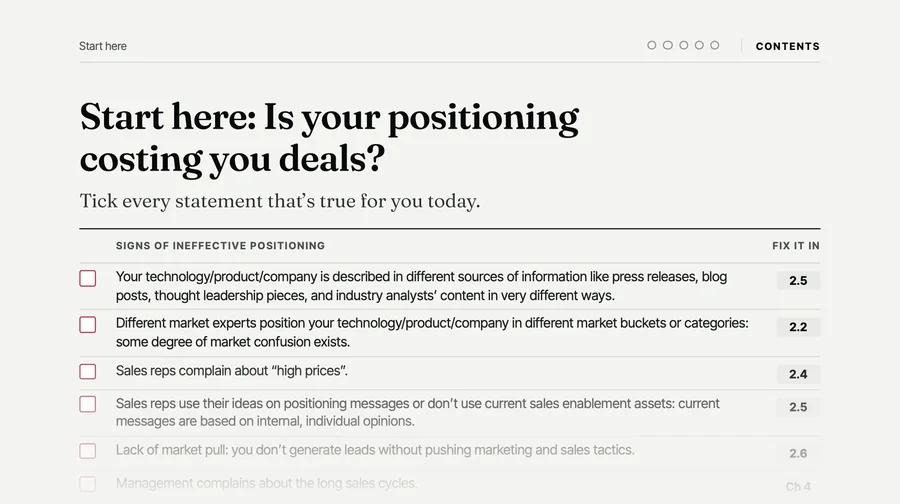
Page 4 of the book: the first checks of the test Is your positioning costing you deals?
Start here. The 20-check test. Each tick points to the section that fixes it.
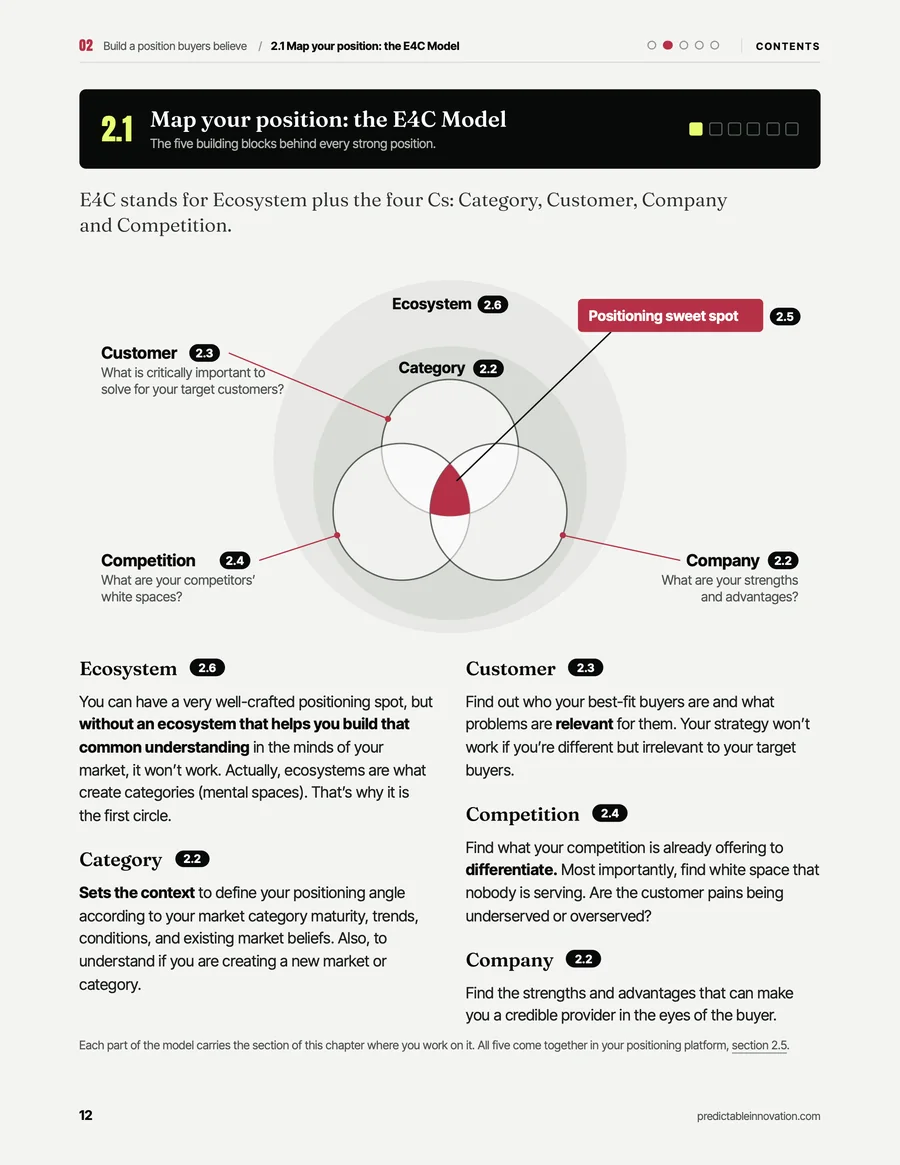
Page 12 of the book: the E4C Model, with ecosystem, category, customer, company and competition around the positioning sweet spot
Chapter 2. The E4C Model: the five building blocks behind every strong position.
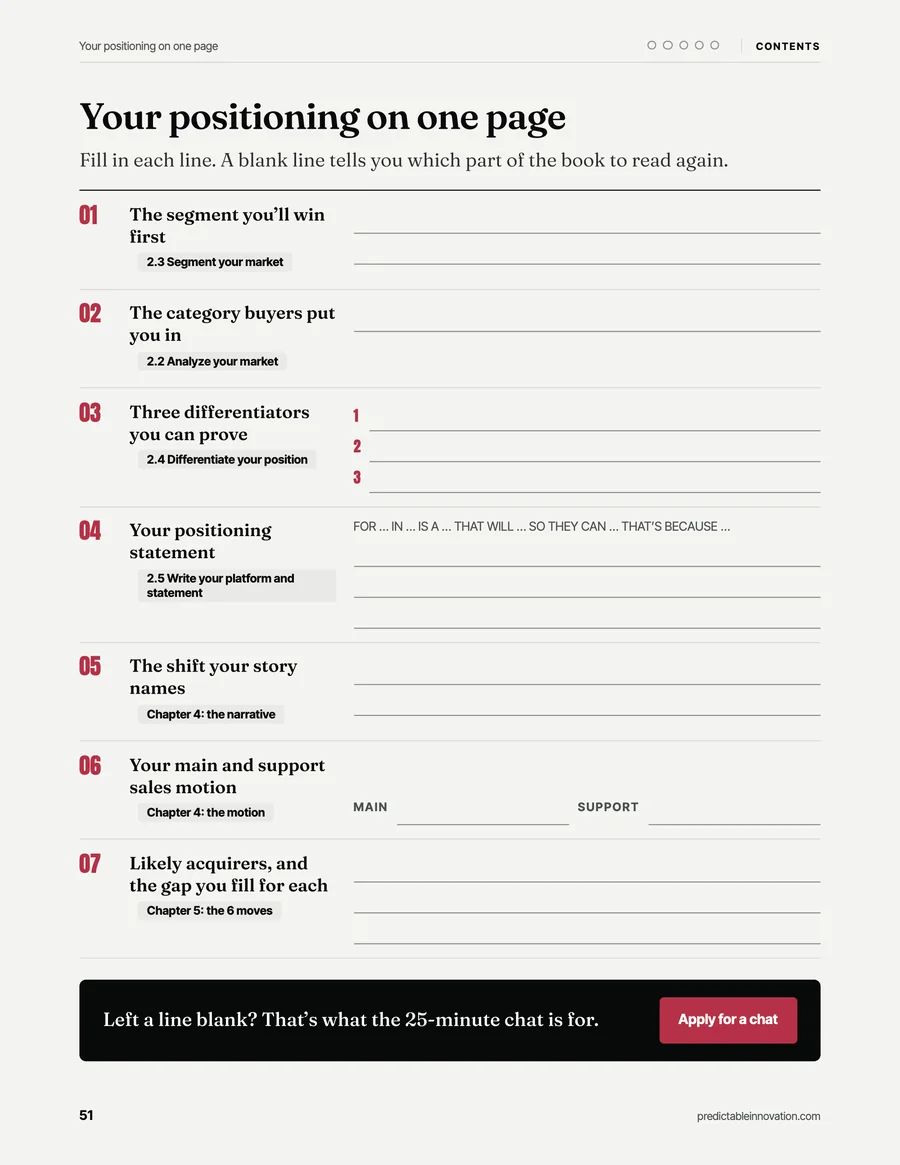
Page 51 of the book: the worksheet Your positioning on one page, with seven lines to fill in
The last worksheet. Your positioning on one page: seven lines to fill in.

What is a positioning strategy?A place in your buyer’s mind.

A positioning strategy decides the place your company or product owns in your buyers’ minds: its perceived status in a market segment, relative to its competitors. It aligns your strengths, your value and how you communicate with what your market needs and already believes. That’s why it guides every key decision, from the market you target to your product priorities.

Anchor it

Anchor your positioning to what the market already believes. An ecosystem of players positions products in people’s minds, so start from their perceptions.

Intangibles first

After product-market fit, a position built on intangibles, like support service, customer base or market leadership, beats one built on tech features.

Own one problem

Unless you’re the absolute market leader, target a specific problem in a specific market segment, and serve that niche better than anyone else.

Test and adjust

No one can be certain of the best positioning ahead of time. Experiment, watch the market’s reaction, and adjust.

The 4 rules for effective positioning, from chapter 1. The formula the book comes back to: segmentation + differentiation = market leadership.

The E4C Model: a positioning framework for B2BFive blocks. One sweet spot.

E4C stands for Ecosystem plus the four Cs: Category, Customer, Company and Competition. Each block points to the section of chapter 2 where you work on it. Where they meet is your positioning sweet spot, and all five come together in your positioning platform.

The five blocks of the E4C Model
BlockThe question it answersIn the book
EcosystemWho helps your market build a common understanding of your position? Ecosystems create categories, the mental spaces buyers sort products into, so this is the first circle.2.6
CategoryWhat sets the context for your positioning angle: your category’s maturity, trends, conditions and existing beliefs? Are you creating a new market or category?2.2
CustomerWhat is critically important to solve for your target customers? Your strategy won’t work if you’re different but irrelevant to them.2.3
CompanyWhat are your strengths and advantages, the ones that make you a credible provider in the eyes of the buyer?2.2
CompetitionWhat are your competitors’ white spaces? Find what nobody is serving, and whether customer pains are underserved or overserved.2.4

Positioning statement templateYour position in one sentence.

The positioning statement sums up your positioning platform in one sentence. It focuses every team on one goal, keeps your marketing on strategy, and helps your sales team set the agenda on something other than price. Here is my adaptation of the classic format, from section 2.5 of the book.

  1. Target audience 2.3

    FOR [audience titles] IN [industry and size]

  2. Category 2.2

    [Product name] IS A [market category or type of product]

  3. What it does 2.3

    THAT WILL [the job to be done: what your product helps them accomplish, or the pains it removes]

  4. Benefits or outcomes 2.3

    SO THEY CAN [the outcomes and benefits your product helps improve]

  5. Differentiators 2.4

    THAT’S BECAUSE [your top differential value attributes for buyers, supported by proof]

A blank line sends you back to the section that fills it. The book also fills one in for Kit, called ConvertKit until 2024. Kit didn’t fight Mailchimp for the whole market. It found an underserved segment, creators, and built everything for it.

Is your positioning costing you deals? The 20-check testTick what’s true today.

The book starts with a 20-check test. Tick every statement that’s true for you today. Each tick points to the section that fixes it, so you can read only those. Here are 6 of the 20.

Six of the 20 signs of ineffective positioning, and where the book fixes each
TickSigns of ineffective positioningFix it in
Different market experts put your technology, product or company in different market buckets or categories: some degree of market confusion exists.2.2
Sales reps complain about “high prices”.2.4
Sales reps use their own ideas for positioning messages, or don’t use your sales enablement assets: your messages come from internal, individual opinions.2.5
Management complains about the long sales cycles.Ch 4
Sales reps and resellers don’t know where to spend their time, whom to call on, and what to say.2.3
Lower than expected stock price or valuation: investors hold on to their investment decisions.Ch 5
0 to 5 checks

Your positioning is in good shape. Re-assess it every 6 months: markets are dynamic, and so is positioning.

6 to 10 checks

You are losing sales opportunities every day because of your positioning. Fixing it must be a top management priority.

More than 10

Your long-term growth is seriously threatened. Clarify your positioning, and set OKRs with strategic initiatives to drive results.

Get all 20 checks: the free book (PDF)

Take it again every 6 months, and track your count.

New in this edition: from positioning to revenue and valueTwo new chapters.

This 2026 edition keeps the original text in a new design, with new chapter titles, worksheets and light edits. I wrote chapters 4 and 5 in 2026 from current research and data, and every source is listed at the end of the book.

Chapter 4, new

Turn your position into revenue

Position first. Then the story. Then the way you sell.

Tell the story in five beats: the shift, winners and losers, the promised land, obstacles, evidence. Then choose the motion your buyers’ profile calls for: sales-led, product-led or partner-led. Four numbers tell you it’s working: a higher win rate, fewer “no decisions”, shorter sales cycles and fewer discounts.

Chapter 5, new

Become a company worth buying

An acquirer is a buyer with a gap. Position yourself as the piece that completes it.

Be related to the buyer, and hard to find anywhere else. Complement several possible buyers, and depend on none. The chapter covers what the research says, the risks of positioning next to a giant, and 6 moves that serve both growth and acquisition.

One story, everywhere: in a Gartner survey published in 2025, 69% of buyers saw inconsistencies between what a supplier’s website said and what its sellers said. Chapter 4 shows you how to write the story once.

Positioning examples: two complements that got boughtComplete the buyer. Don’t compete with it.

Two companies whose positioning I worked on. Chapter 5 tells what their acquirers said: notice the words they used.

Acquired by SolarWinds, March 2025

Squadcast

Different from the rivals. Complementary to the buyer.

What I recommended
Squadcast wanted to create a new category, “Site Reliability Engineering”. I recommended keeping “Incident Response Software”. Its positioning was built to complement its acquirer’s platform, not compete with it.
What happened
When SolarWinds announced the deal, it described Squadcast as an advanced alternative to PagerDuty and Opsgenie that would complement its current portfolio and help its customers resolve incidents faster.

Acquired by Overjet, December 2025

DentalBee

One clear gap, filled for a buyer that already knew it.

What changed
DentalBee narrowed its positioning.
What happened
When Overjet announced the deal, it said the acquisition extends its AI suite into real-time clinical documentation and coaching. Overjet’s CEO added that the two teams had been working together for months before the deal.

Both were acquired after a positioning strategy workshop with me. If your positioning already says what you complete, you’ve written half of your acquirer’s announcement.

What teams say about the go-to-market workshop

Jose’s go-to-market strategy workshop has been instrumental in clarifying our product positioning strategy and launch plan! Their methods and deep understanding of technology markets are unmatched to commercialize high-tech innovations. They’re the go-to team if you need help launching a new tech-based product or Innovation!

Lya RebeloGo-to-Market Strategy at Citeline

Who wrote the book

Jose M Bermejo

Jose M Bermejo

Positioning and go-to-market consulting for B2B companies

  • Go-to-market and positioning work with 50+ B2B tech companies worldwide, and 100+ workshops run.
  • 15+ years selling B2B tech, first as a chief revenue officer who grew revenue 120%.
  • Trained leaders in go-to-market strategy at Meta, Webflow, Android, Grammarly and Atlassian.
  • $10M+ in deals I closed myself, from $5K to $1M each.
  • Executive MBA, IESE Business School.

I’m the founder of Predictable Innovation. In positioning consulting and go-to-market workshops, my clients’ leadership teams and I make the decisions this book teaches, together.

Some of the 50+ B2B tech companies I’ve run go-to-market and positioning work with

  • YPX Realty
  • Virnect Global
  • SolarWinds
  • Citeline
  • Scale Factory
  • Shooju
  • Introhive
  • DentalBee
  • Simplisure
  • Callstack

Who the positioning book is forFor B2B software and tech.

Best for

  • Founders, CEOs and CROs of B2B software and tech companies.
  • Teams whose website, analysts and sales reps describe the company in different ways.
  • Companies moving from early adopters to mainstream buyers, who want proof and low risk.
  • CEOs who want a company buyers need and acquirers can’t ignore.

Not a fit if

  • You want a tagline. Chapter 1 asks for the sentence your best customer would use to describe you to a peer, not a tagline.
  • You sell to consumers. Every chapter is about B2B buyers.
  • You want help making the calls with your team. That’s positioning consulting.

Help with your positioning strategyReading is the easy part. Choosing is hard.

Which segment, which category, which story, which motion. These calls feel risky, and teams argue about them for months. Let’s make them together.

  1. STEP 125 minutesFree

    Exploratory chat

    We look at where your positioning and go-to-market stand today, and whether I can help you move faster. If I can’t, I’ll tell you.

    Ticked 6 or more checks, or left a line blank on your one-page positioning? Bring it to the chat.

    Book a 25-minute exploratory chat

  2. STEP 2Your team and me

    Positioning consulting

    Your leadership team and I decide the market you compete in, the buyers who value you most and why you win against the alternatives. Then we turn it into the words your website and your sales team use.

    Prefer a short format? Make the decisions in a go-to-market workshop. See positioning consulting

Positioning strategy book: questions

What is a positioning strategy?

A positioning strategy decides the place your company or product owns in your buyers’ minds: its perceived status in a market segment, relative to its competitors. It aligns your strengths, your value and how you communicate with what your market needs and already believes. In my book, you build it from five blocks, the E4C Model: ecosystem, category, customer, company and competition.

What is the E4C Model?

The E4C Model is the positioning framework in my book. E4C stands for Ecosystem plus the four Cs: Category, Customer, Company and Competition. You work on each block in the section of chapter 2 it points to, find the sweet spot where they meet, and bring all five together in your positioning platform and a one-sentence positioning statement.

How do you write a positioning statement?

Fill in one sentence: FOR [audience titles] IN [industry and size], [product name] IS A [market category], THAT WILL [the job it does], SO THEY CAN [the outcomes], THAT’S BECAUSE [your top differentiators, supported by proof]. Decide your segment, category and differentiators first. If you can’t fill in a line, go back to the section of the book that fills it.

Is the positioning strategy book free?

Yes. The Art of B2B Software Positioning Strategy is a free 54-page PDF. You get it right away by entering your email and mobile number in the form on this page. It includes the 20-check test, the five chapters, their worksheets and a one-page worksheet for your whole positioning.

Who is the positioning book for?

Founders, CEOs and CROs of B2B software and tech companies. It helps most when your website, analysts and sales reps describe you in different ways, when reps complain about high prices, or when your market is moving from early adopters to mainstream buyers who want proof and low risk.

How is it different from Positioning by Ries and Trout, or Obviously Awesome?

Al Ries and Jack Trout’s Positioning: The Battle for Your Mind is the classic on owning a place in the customer’s mind. Chapter 4 quotes April Dunford, author of Obviously Awesome: “Stories require positioning as an input.” My book is for B2B software and tech. It adds how positioning changes as your market matures, the market ecosystem that makes buyers believe you and, new in this edition, how to turn your position into revenue and into a company acquirers want.

What’s new in this edition?

This 2026 edition keeps the original text of the book in a new design, with new chapter titles, worksheets and light edits for clarity. Two chapters are new: chapter 4, Turn your position into revenue, and chapter 5, Become a company worth buying. I wrote both in 2026 from current research and data, and every source is listed at the end of the book.

Get the free positioning book.

54 pages: a 20-check test, five chapters, worksheets and your positioning on one page. Free: enter your email and mobile number in the form at the top, and the download starts right away.

Cover of Positioning Strategy, The Art of B2B Software, by Jose M Bermejo

The Art of B2B Software Positioning Strategy, by Jose M Bermejo. With contributions from Warren Schirtzinger. A 54-page PDF, 2026 edition.

Get the free book (PDF)